


It’s not easy to run a loan book in India. Being a Non-Banking Financial Company or a Microfinance Institution, ensuring timely repayments from thousands of borrowers across geographical locations is a daily challenge. It’s here where the best debt collection software turns from a luxury to a mandatory part of the business.
However, the majority of lenders still make this decision at the end of the day and find the first tool they came across in a search or use the same “legacy” CRMs that were not designed for collections. This leads to inefficient agents, low recovery rates and the borrower’s experience that washes away trust. Here’s what it really takes to consider when buying debt collection software for your NBFC or MFI.
Before shortlisting any items, you should first learn what’s in your portfolio.Before shortlisting anything, it’s essential to know what you have in your portfolio.
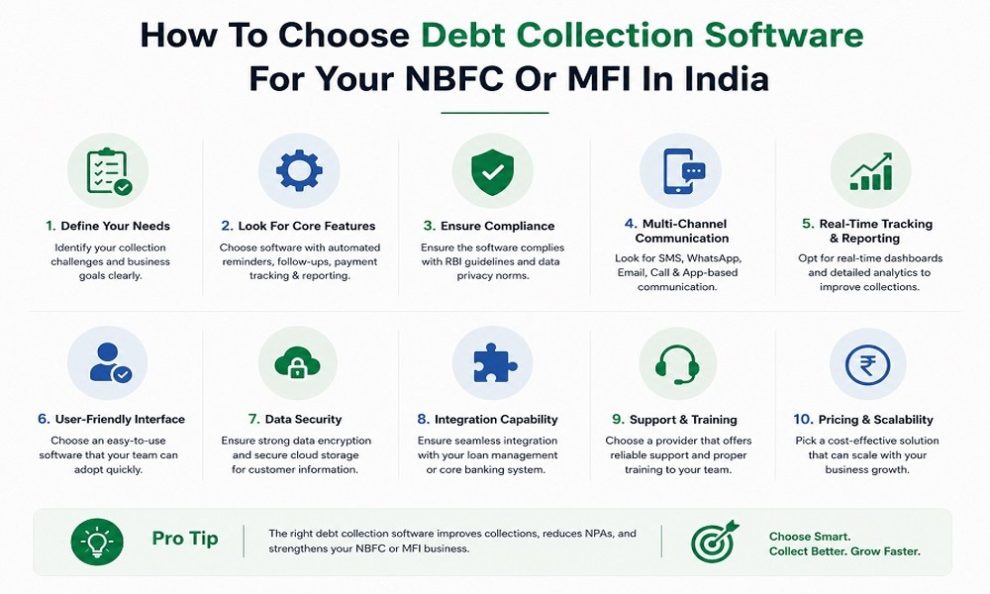
Prior to comparing vendors, outline your operations. MFI working on joint liability groups in rural Bihar has completely different collection processes as compared to an NBFC making personal loans to a salaried individual in Bengaluru. You need to ensure that the debt collection software you select is ideal for your ticket size, loan duration, location and the educational ability of your agents in the field.
How many field agents do you have? Is the collection conducted online or face-to-face? Are you looking for multi-lingual assistance? These responses will rule out many tools on the market right off the bat.
The following are some of the most important features that cannot be compromised:
Compliance with RBI’s Fair Practices Code and the 2022 digital lending guidelines, built in – Every Debt Collection Software in India will be compliant with RBI’s Fair Practices Code and 2022 digital lending guidelines. Ensure that audit trails, call recordings, and communication logs are recorded in native form.
Vernacular language support – There are more than 10 languages that Borrowers speak across India. The MFIs have no choice in which language their field-facing modules are in; it impacts on the collections performance.
Offline-first mobile apps: Mobile apps are often used offline, in low connectivity areas, often by field agents in semi-urban and rural areas. Debt collection software should enable agents to make changes to records without an internet connection and automatically synchronize it again once they connect.
Manual follow-up on each DPD bucket is not sustainable; automated escalation workflows. Identify rule based engines that route accounts based on days past due, loan type, and geography without the need for human intervention.
Beware of the following red flags:
There are many vendors that actively sell their debt collection software, and then provide substandard service once the software is installed. When a vendor is unable to show a working sandbox during the initial call, be wary. Likewise, if they don’t have case studies of NBFCs or MFIs in India, then the solution can be poorly suited to the regulatory and operational environment in India.
The costs of SMS/WhatsApp messaging or data storage or agent licenses are often only revealed upon signing. Request an estimate of TCO including your estimated loan book for 24 months.
Even the best in debt collection software will fail to deliver the maximum benefits if it remains unutilized or if it doesn’t get the team properly trained or gets implemented beyond the next disbursement cycle. Look for vendors that provide onboarding teams, not onboarding links. The gradual introduction – one branch at a time or one loan product at a time – is often more feasible than a whole deployment.
Conclusion
Choose for Your Borrowers, Not Just Your Balance Sheet
The right debt collection software does two things simultaneously: it improves your recovery rates and it treats borrowers with the dignity they deserve. In India’s regulated lending environment, both matter equally. Take the time to evaluate tools against your actual operations, demand RBI-compliance proof, and prioritize usability for field agents who will use it every single day.
A thoughtful investment in debt collection software today is what separates NBFCs and MFIs that scale cleanly from those that struggle with mounting NPAs and operational chaos tomorrow.




Add Comment